
Fish Chart
Caught a fish and want to know its weight without a scale — or planning to release it quickly? Measure the length and girth, and this fish chart estimates the weight with the widely used angler’s formula. A printable weight chart lets you look up weights by length and girth, and the guide explains measuring, body-shape factors and catch-and-release handling.
- Free to use
- No sign-up
- Runs in your browser
Quick answer
Calculate fish weight by measuring total length and girth at the thickest point, then use: weight (lb) = length (in) × girth² (in) ÷ 800. Use the actual girth whenever possible; for a rough musky estimate choose the slender option (÷900), while striped bass usually fit the general formula unless unusually thin or heavy.
Fish weight calculator
Angler’s Fish Chart & Catch Log
Printable fish weight chart (length × girth, inches and centimetres), a waterproof-paper-friendly catch log, a catch-and-release card and an Excel catch diary with automatic weight estimates.
- Weight chart (inches)
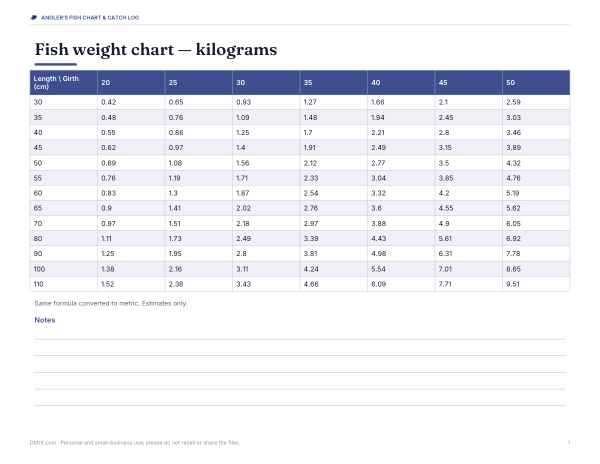
- Weight chart (metric)
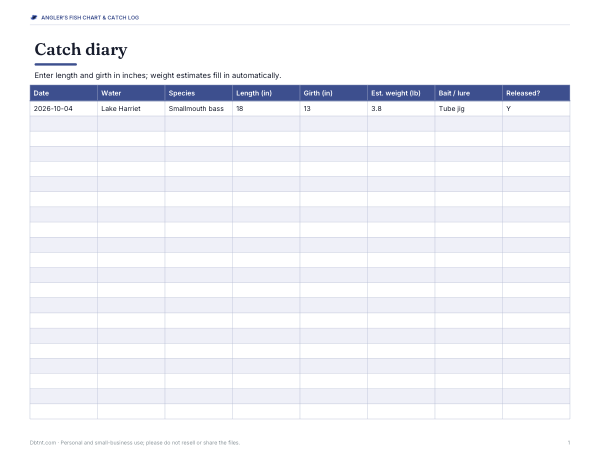
- Catch diary (XLSX)
- Release card (PDF, DOCX)
Formats: PDF, XLSX, DOCX. Instant download after payment (link valid 72 hours, up to 5 downloads). AI-assisted: the templates were drafted with AI help and reviewed and laid out before publishing.
$3.00 USD, one-time 4 files · about $0.75 each
- Instant download
- 7-day refund
- Secure checkout by Stripe
7-day money-back guarantee. Full refund within 7 days of purchase, even after you download.
Free sample: Catch And Release Card (PDF, 63 KB)
Full refund within 7 days — see the refund policy and license.
Free printables
Single sheets you can print right now, no sign-up. The full pack adds every sheet in one download plus the editable files.
 Printable Release Card
Example fish weight calculations
These examples use the same length × girth² method as the calculator; use your own measurements for the best estimate.
| Fish/example | Length | Girth | Divisor | Est. weight |
|---|---|---|---|---|
| General | 20 in | 12 in | 800 | 3.6 lb / 1.6 kg |
| General | 30 in | 16 in | 800 | 9.6 lb / 4.4 kg |
| Striped bass | 36 in | 20 in | 800 | 18.0 lb / 8.2 kg |
| Striped bass | 42 in | 24 in | 800 | 30.2 lb / 13.7 kg |
| Musky | 40 in | 18 in | 900 | 14.4 lb / 6.5 kg |
| Musky | 45 in | 20 in | 900 | 20.0 lb / 9.1 kg |
| Musky | 50 in | 24 in | 900 | 32.0 lb / 14.5 kg |
The angler’s weight formula
Because most of a fish’s weight comes from its volume, weight rises with length times girth squared. The traditional formula, used by anglers for decades, is weight (lb) = length (in) × girth (in)² ÷ 800. A fish 20 inches long with a 12-inch girth works out at 20 × 144 ÷ 800 = 3.6 lb. Some anglers adjust the divisor by body shape — a larger one for deep, compressed fish such as bass and crappie, whose girth overstates their volume — so the calculator also offers ÷ 1200 for deep-bodied fish and ÷ 900 for long, slender fish as rough alternatives. Treat all these as estimates: condition, season and species all change the true weight.
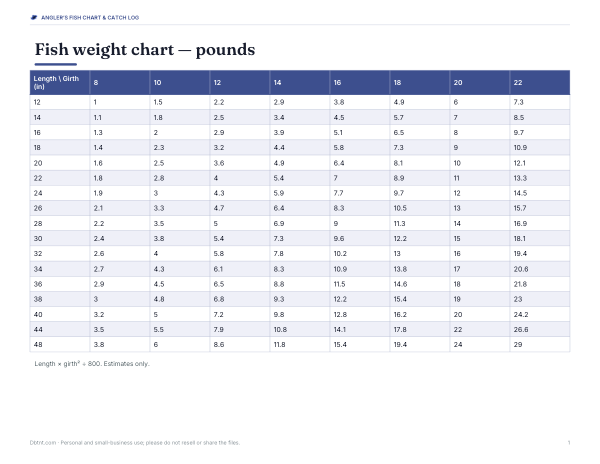
Fish weight chart (general formula)
| Length (in) \ Girth (in) | 8 | 10 | 12 | 14 | 16 | 18 | 20 |
|---|---|---|---|---|---|---|---|
| 14 | 1.1 | 1.8 | 2.5 | 3.4 | 4.5 | 5.7 | 7.0 |
| 16 | 1.3 | 2.0 | 2.9 | 3.9 | 5.1 | 6.5 | 8.0 |
| 18 | 1.4 | 2.3 | 3.2 | 4.4 | 5.8 | 7.3 | 9.0 |
| 20 | 1.6 | 2.5 | 3.6 | 4.9 | 6.4 | 8.1 | 10.0 |
| 22 | 1.8 | 2.8 | 4.0 | 5.4 | 7.0 | 8.9 | 11.0 |
| 24 | 1.9 | 3.0 | 4.3 | 5.9 | 7.7 | 9.7 | 12.0 |
| 26 | 2.1 | 3.3 | 4.7 | 6.4 | 8.3 | 10.5 | 13.0 |
| 28 | 2.2 | 3.5 | 5.0 | 6.9 | 9.0 | 11.3 | 14.0 |
| 30 | 2.4 | 3.8 | 5.4 | 7.3 | 9.6 | 12.2 | 15.0 |
| 34 | 2.7 | 4.3 | 6.1 | 8.3 | 10.9 | 13.8 | 17.0 |
| 38 | 3.0 | 4.8 | 6.8 | 9.3 | 12.2 | 15.4 | 19.0 |
| 42 | 3.4 | 5.3 | 7.6 | 10.3 | 13.4 | 17.0 | 21.0 |
Values in pounds using length × girth² ÷ 800. Not every combination occurs in real fish — a 14-inch fish will not have a 20-inch girth — so use the column closest to your measurement.
How to measure a fish
- Wet your hands and keep the fish over the water or a wet mat.
- Length: lay the fish on a measuring board with its mouth closed and against the end; measure to the tip of the tail. Many regulations use total length with the tail lobes pinched together — check your local rules.
- Girth: wrap a soft tape measure around the thickest part of the body, usually just in front of the dorsal fin.
- Take a quick photo with the fish beside the tape if you want a record.
- Return the fish to the water promptly, supporting it until it swims away.
A cloth tape or a length of string marked afterwards against a ruler works if you do not carry a soft tape.
Body shape factors
| Shape | Examples | Typical girth ÷ length | Divisor used here |
|---|---|---|---|
| Deep-bodied | Largemouth and smallmouth bass, crappie, sunfish, carp | roughly 0.6–0.75 | 1200 |
| Average | Walleye, salmon, catfish | roughly 0.5–0.6 | 800 |
| Slender | Pike, muskie, trout, gar | roughly 0.35–0.5 | 900 |
The ratio column is used only when you do not enter a girth; it is a rough typical value to give a ballpark figure. A well-fed autumn fish can be much heavier than a thin post-spawn fish of the same length.
Why estimate instead of weighing?
Weighing a big fish in a net or with a lip grip can injure it, and scales are not always at hand. For catch-and-release fishing, the kindest approach is a quick length and girth measurement and a photo, followed by release within seconds. Many clubs and some record programs accept length-based entries for this reason. If you do weigh a fish, support its body in a wet weigh sling rather than hanging it by the jaw, and subtract the sling’s weight.
Worked example
An angler lands a smallmouth bass 18 inches long with a 13-inch girth. With the general formula, 18 × 169 ÷ 800 = 3.8 lb; with the deep-bodied divisor, 18 × 169 ÷ 1200 = 2.5 lb. Real fish of that size vary with condition and season, and the true weight often lies between the two estimates — which is why the formula is best used for bragging-rights estimates and comparisons, not official records.
Catch-and-release tips
- Use barbless or crimped hooks for quick unhooking.
- Keep the fish in the water as much as possible; limit air exposure to a few seconds.
- Hold fish horizontally with support under the belly, especially large ones.
- Avoid touching the gills and do not squeeze.
- Revive the fish facing into the current until it swims off strongly.
- In hot weather, keep fights short and avoid fishing for stressed species.
Size limits and regulations
Minimum and slot size limits protect breeding fish and vary by species, water and season. Always check the current regulations for the water you fish — they are published by the relevant fisheries or wildlife agency. Measure accurately: a fish just under the limit must be released, and some rules specify how the tail is measured.
Record keeping
Keeping a log of catches — date, place, species, length, girth, estimated weight, bait and conditions — helps you spot patterns in when and where the bigger fish bite. The printable catch log in the paid pack is designed for quick notes on the bank or boat.
Privacy
The calculator runs in your browser; nothing is stored or sent anywhere.
Frequently asked questions
How do I calculate musky weight?
Measure the musky’s length and girth, then use length × girth² ÷ 900 for the slender-fish option on this page. It is still an estimate, and a very heavy or very thin musky can vary from the result.
How do I calculate striped bass weight?
Use the general angler’s formula: length in inches × girth in inches squared ÷ 800. For the closest estimate, measure girth instead of relying on length alone.
Is a length weight chart accurate without girth?
A length-only chart is only a rough estimate because fish of the same length can have very different girths. Length plus girth is usually the better quick method for catch-and-release fishing.
How do I estimate a fish’s weight from its length?
Measure length and girth and use weight (lb) = length × girth² ÷ 800; without girth, the estimate is much rougher.
Where do I measure girth on a fish?
Around the thickest part of the body, usually just ahead of the dorsal fin.
Why does the bass formula use 1200?
Deep, compressed fish have a large girth relative to their volume, so a larger divisor gives a more realistic estimate.
Are formula weights accepted for records?
Usually not for weight records; many record programs require certified scales. Some have separate length categories.
How do I convert to kilograms?
Multiply pounds by 0.4536, or switch the calculator to metric.
Is my data stored?
No, it runs in your browser.